

The story of every love is reflected in two jewels that recount its key milestones: the engagement ring and the wedding band. If the former is the eternal symbol of union and an unbreakable bond, the latter represents the promise—the moment when a feeling turns into a shared life project. Two creations that speak to each other along a journey made of emotion, tradition, and personal choices.
Understanding the meaning that connects the wedding band and the engagement ring does not only mean knowing their differences, but also rediscovering a heritage of gestures and traditions passed down through generations, while remaining open to modern and personalized interpretations.
In this article, we will explore the symbolic value of these jewels, the curiosities tied to the wearing of the wedding band and engagement ring, and the allure of unique wedding bands designed to tell a story that is one of a kind and unrepeatable.
Engagement ring and wedding bands: traditions and etiquette
The engagement ring has its roots in antiquity, when the circle was considered a symbol of a pact of love and eternal fidelity. Over the centuries, this tradition has been enriched with rules of etiquette, which still today accompany the moment of the proposal.
According to the most widespread custom, it is the future groom who gives the ring to his partner, choosing it with care. It does not need to be lavish: what truly matters is its harmony with the recipient’s style and the meaning it carries, rather than its material value. This is the detail that makes the ring an authentic symbol of promise and a shared future.
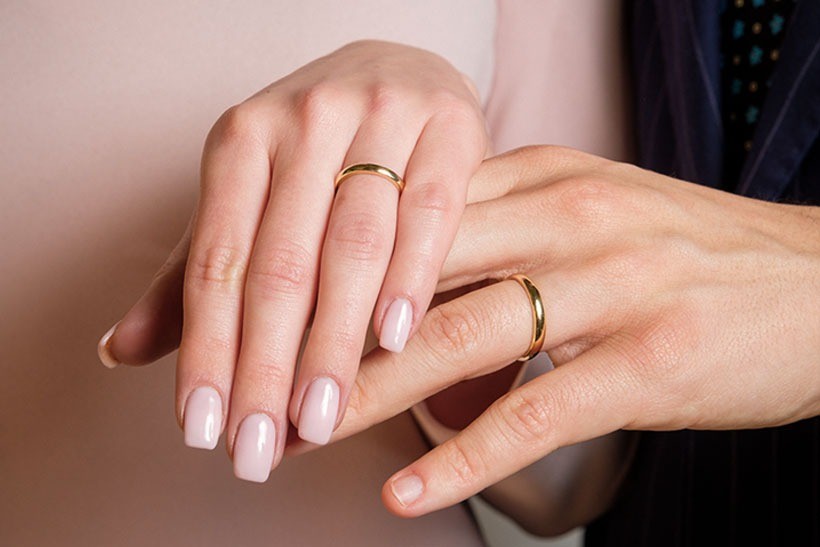
The wedding band, on the other hand, represents the fulfillment of that promise and is the jewel that, more than any other, embodies marriage. While in the past it was the groom’s sole responsibility to purchase it, today the choice is often shared by the couple, turning the moment into a gesture of union. During the ceremony, the rings are exchanged as the seal of the “I do” and are usually worn on the left ring finger, following the tradition of the vena amoris—the vein once believed to run directly from that finger to the heart.
The solitaire: the quintessential engagement ring
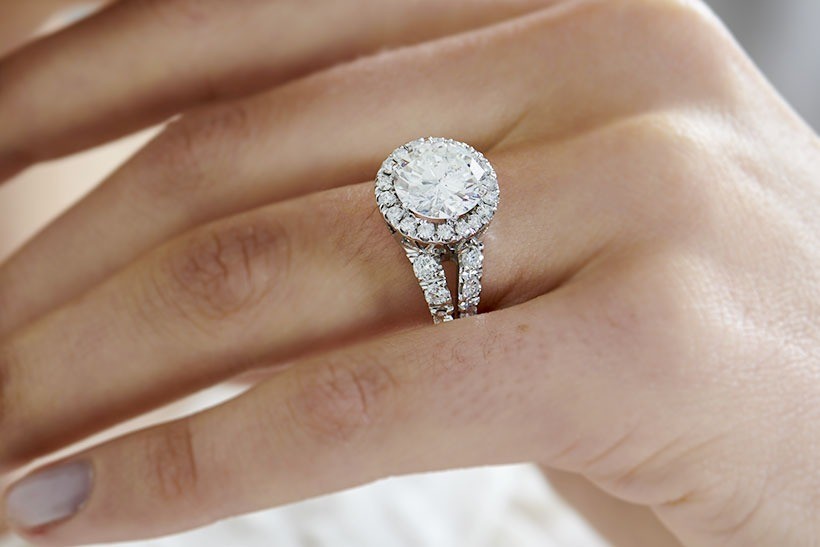
Among the different types of engagement rings, the solitaire holds a special place in the collective imagination. Its strength lies in its simplicity: an essential setting that highlights a single precious stone, almost always a diamond.
The tradition of giving a solitaire as a promise of love spread in the 19th century, when the diamond became the universal symbol of eternity. The purity of the stone, combined with its brilliance, speaks of the strength and endurance of a bond.
What makes it so beloved is also its timeless elegance: a design that does not follow trends, but remains relevant in every era. Moreover, the solitaire is extremely versatile, as it naturally pairs with the wedding band, creating a harmonious and refined ensemble.
This is why, despite the existence of alternatives such as the trilogy or the riviera with diamonds, the solitaire remains the most popular choice: a jewel capable of speaking a simple and universal language, recognized by all as an authentic symbol of promise and eternal love.
Placement of the wedding band and engagement ring: a cross-cultural perspective
One of the most frequent questions concerns the placement of the wedding band and the engagement ring: where should they be worn, and in what order? The answer varies depending on cultural and religious traditions.
In Italy, tradition holds that the engagement ring is worn on the left ring finger until the wedding day. After the ceremony, some choose to place it alongside the wedding band, while others prefer to keep it on the opposite hand — a decision guided by personal style.
In the United States, by contrast, both the band and the engagement ring are worn together, always on the left ring finger. The band is placed first, closer to the heart, with the engagement ring immediately above it, as if to protect it.
In Germany and several Central European countries, as well as in Greece and within Eastern Orthodox Christian traditions, the wedding band is worn on the right hand. The reasoning is symbolic: the right hand is considered the hand of truth, strength, and divine blessing. Wearing the ring on that finger thus seals the marriage with a gesture of faithfulness and righteousness.
Beyond cultural differences, what unites all traditions is the same essence: wearing the wedding band and engagement ring as a tangible symbol of a love that grows and renews itself.
Unique wedding bands: the singularity of an eternal symbol
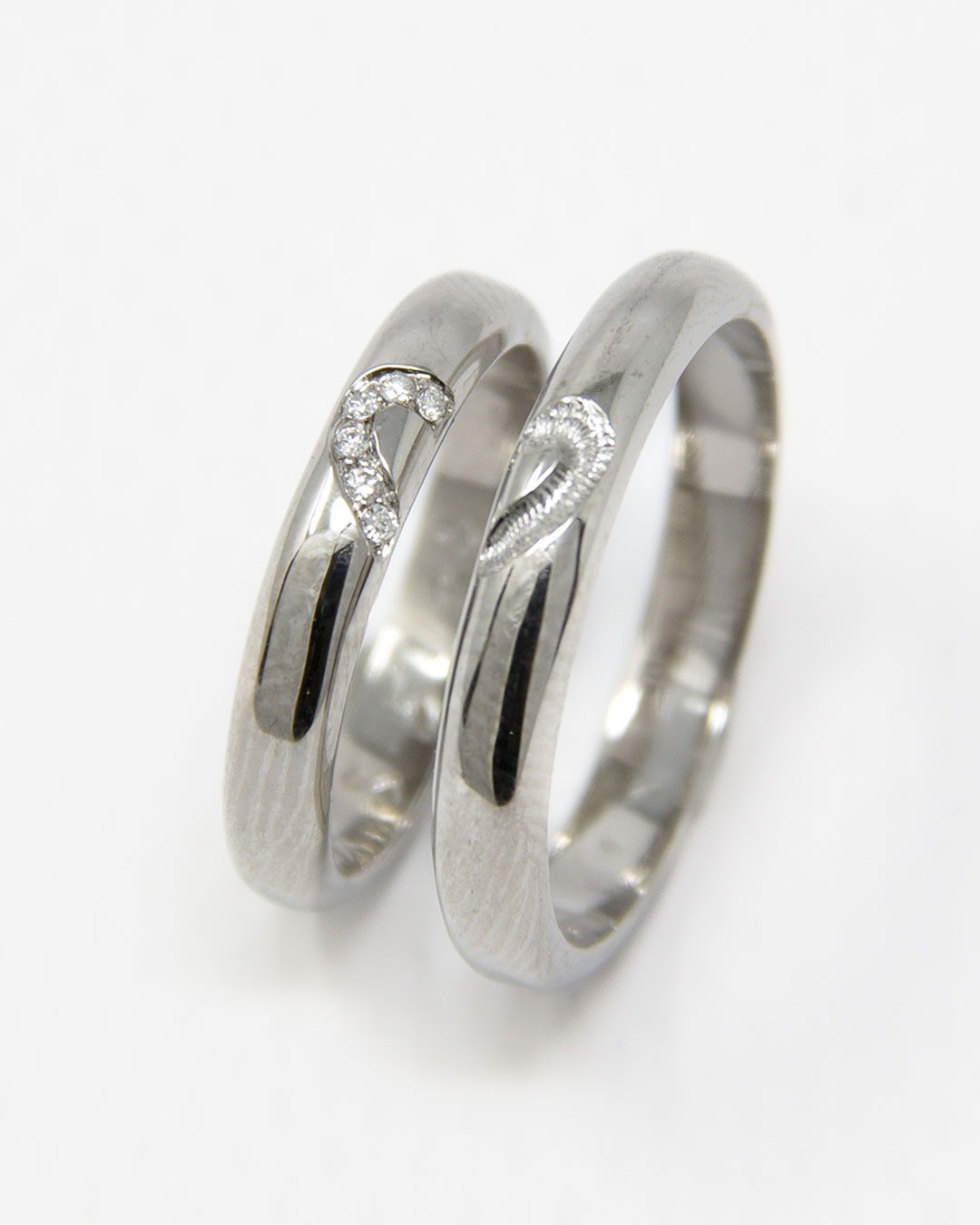
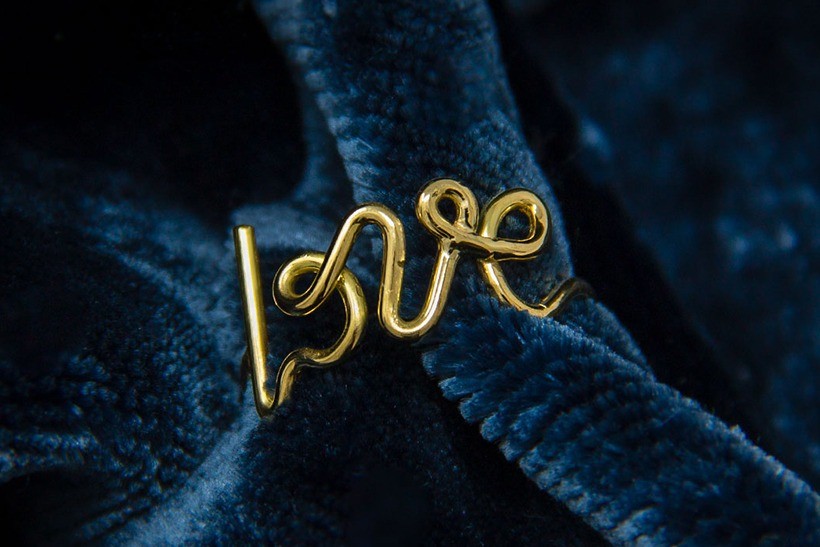
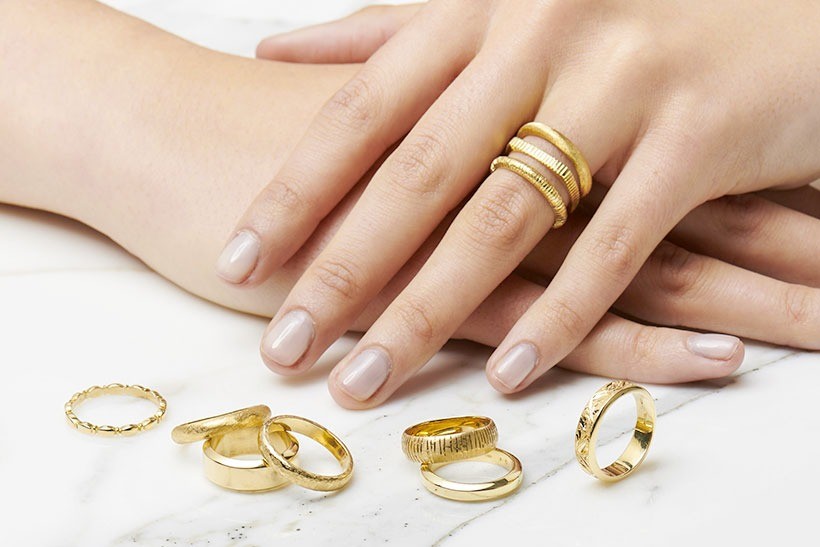
If the classic yellow gold wedding band has always been the ultimate symbol of marriage, today many couples choose to make it even more personal by opting for unique wedding bands. This is not just a simple aesthetic detail, but a way to tell their love story through something one-of-a-kind and unrepeatable.
The possibilities are many: from handcrafted textures inspired by natural or geometric motifs, to unconventional shapes such as squared profiles or asymmetrical designs. Some couples choose combinations of different metals, like intertwined white and rose gold, while others prefer subtle yet precious details, such as a small diamond set inside the ring.
The defining element is always craftsmanship: every handmade detail gives the rings an exclusive character, turning them into true works of art to be worn every day. It is precisely this uniqueness that makes a distinctive wedding band not just a jewel, but an eternal memory, capable of reflecting the couple’s personality and the values that unite them.
For those seeking inspiration from real examples, it is possible to explore our Signature Wedding Bands—artisanal creations that show how tradition and innovation can come together in a single jewel.
Engagement Ring and Wedding Band: a bond that becomes art
Traditions, customs, and even the placement of the engagement ring and wedding band vary across countries and eras, but the meaning remains universal. Every choice—whether tied to the simplicity of the classic band or the originality of a unique design—reflects the couple’s identity and their vision of the future.
In the heart of Florence, Vannini Gioielli interprets this journey with the mastery of Florentine goldsmithing, transforming each creation into a one-of-a-kind piece. Because the wedding band and the engagement ring are not just jewels, but chapters of a story that deserves to be told with elegance and authenticity.