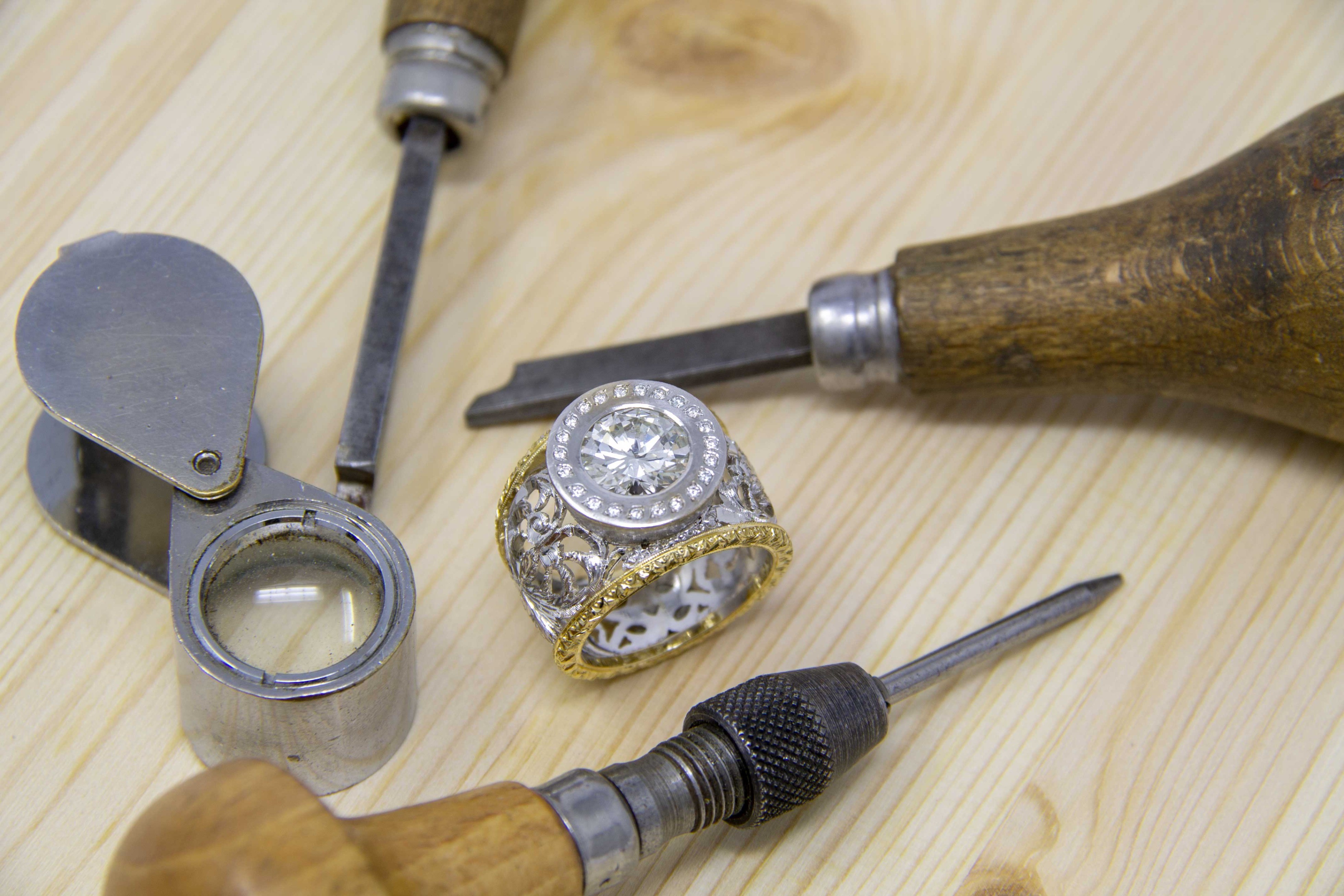


A well-made engraving isn’t just a detail—it’s the signature that makes a piece truly yours. In this practical guide we explore the engraving techniques most used in jewelry—from traditional burin work to supporting processes like chasing and stippling—to decide when to choose them, which pieces they suit best, and how they affect light, depth, and longevity.
Inside you’ll find examples, tips, and ideas for personalized engraved jewelry, along with clear, accurate steps of the making process. The journey is told through the artisan eye of Vannini Gioielli, a Florentine workshop where every mark begins with listening, design, and a master’s hand.
What is jewelry engraving, and why does it make a piece unique?
Jewelry engraving is the art of cutting into metal—gold, silver, or platinum—using hand tools (like a burin) or precision technologies to create permanent lines, patterns, and inscriptions. It’s an ancient tradition that goes beyond the surface: every groove shapes the material, catches the light, and defines the character of the piece.
Why does engraving make a jewel unique?
-
Personalization: a date, a monogram, a symbol—a detail that speaks for you and tells your story. An engraved ring or pendant becomes instantly unrepeatable.
-
Craft value: with burin engraving, the master’s hand controls pressure and cutting angle; micro-differences that create lively reflections and a texture impossible to reproduce in series.
-
Style: from Florentine ornament to contemporary geometric motifs, engraving elevates simple forms and can turn a classic into a bespoke piece.
Engraving techniques: how to choose the right one
In jewelry engraving, the result comes from the interplay of four variables: the tool geometry (for example, a V- or U-shaped graver), the metal, and the hand’s angle and pressure. From this balance emerges the “character” of the mark—deep and crisp for maximum legibility and longevity; fine and closely spaced when you want brightness and gradation.
The outcome changes noticeably with the alloy. Yellow gold, being more ductile, welcomes continuous, deep cuts with softer edges; silver, highly reflective, tends to raise a burr and calls for lighter passes and more meticulous finishing. Platinum, a tough metal, yields very thin, sharply defined lines but requires longer working times.
So, which are the most widely used hand-engraving techniques?
The main hand-engraving techniques
Among the main hand techniques, standouts include burin engraving and stippling. The latter builds areas and tonal transitions with a pattern of regular micro-strikes: it softens mirror-like reflections, improves the legibility of tiny subjects—such as stars, constellations, and background textures—and is ideal when you want the main motif to pop against the field, especially on pieces with personalized engraving.
Burin engraving: the Florentine tradition
Queen of traditional techniques, burin engraving is done by pushing a small chisel into the metal to create crisp, highly polished cuts that catch the light. In the Florentine school it’s synonymous with craftsmanship and style: scrolls, foliage, and micro-hatching add depth even to the simplest surfaces. The result is a lively, vibrant line—unique with every pass—with an exceptionally high degree of customization, perfect for wedding bands, signet rings, bracelets, and pendants, and a durability that stays with the jewel over time, because the mark sits within the alloy, not just on the surface.
The "Ciappola” engraving of Florence
In Florence, within goldsmiths’ workshops, the term “ciappola” refers to a particular type of burin (engraving tool).
Among the different kinds of ciappola, for example, there is the ciappola fine: a “comb-shaped” burin that, with a single pass, engraves thin, parallel lines, creating regular textures that modulate the light.
With the ciappola, the goldsmith can give the metal a variety of expressive qualities:
-
Setatura: dense, regular striations that create a textile-like effect;
-
Granitura/Segrinatura: stippling or cross-hatched micro-lines that matt the background.
These “soft” surfaces make burin-cut subjects (letters, symbols, rosettes) stand out, enhance legibility, and disguise micro-scratches from everyday wear (useful on bracelets and the outer faces of wedding bands). The ciappola calls for a light hand and steady rhythm: the density, direction, and crossing of the lines determine the degree of satin finish and how much light is diffused.
Choosing the hand technique—from burin engraving to stippling—and the related depth is an integral part of designing jewelry with personalized engraving: the hardness and ductility of the metal determine the crispness of the mark, the quality of the light, and the execution time.
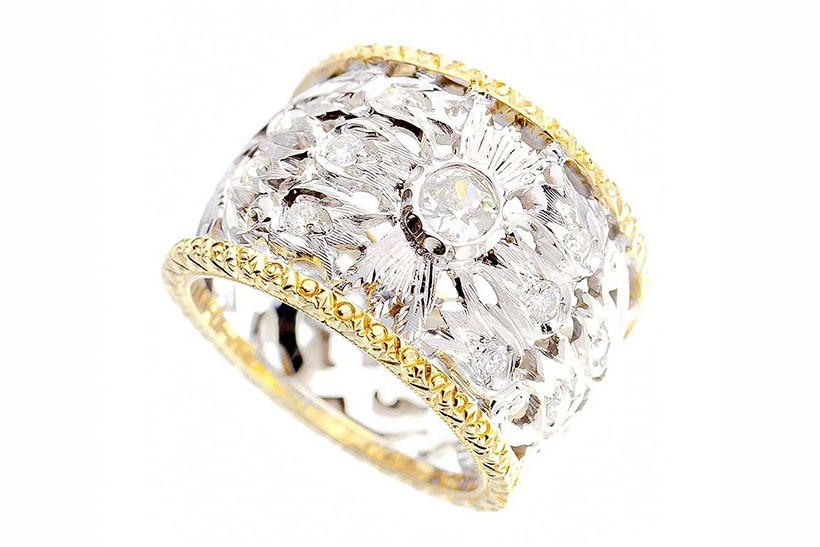
Perforated and engraved band ring, with diamonds
Engraving techniques: differences between hand engraving and laser engraving
In jewelry engraving, hand techniques are defined by the direct relationship between tool, gesture, and metal: the hand guides the light, modulates depth, and gives the line its character. Compared with laser engraving, the difference is not only technological but above all expressive. Hand engraving—especially burin work—offers adjustable depth and those small “noble imperfections” that bring a motif to life, ideal for personalized pieces and complex decoration. Laser engraving, by contrast, prioritizes precision and repeatability: perfect for logos, modern fonts, strict geometries, tiny details, and for ensuring consistency across multiple pieces.
At Vannini Gioielli, we combine these techniques according to the design, the metal, and the piece’s intended use, to achieve personalized engravings that are legible, durable, and true to your style.
What Can Be Engraved: Motifs, Sizes, and Legibility
What can be engraved: subjects, sizes, and legibility
With hand-engraving techniques you can create inscriptions, monograms, dates, symbols, heraldic crests, micro-illustrations, and decorative textures. The choice of subject should be calibrated to scale, depth, and the base metal.
- Inscriptions and monograms: For wedding bands and rings, simple, regular letterforms (clean sans-serif or readable cursive) ensure recognizability even after polishing. As a rule, below 1.2–1.4 mm letter height, legibility declines; with burin engraving, you can reinforce stems and serifs to boost contrast.
- Crests and symbols: These call for a clean vector drawing and a clear hierarchy of strokes (deeper outlines, fills in stippling or sgraffito). On small surfaces, it’s wise to simplify fine elements to avoid a buildup of marks.
- Patterns and textures: Cross-hatching, stippling, and light scratches modulate light and create satin backgrounds that make the main motif “pop.” Useful when you want to separate ground vs. figure without pushing depth too far.
- Minimum thickness and depth: On thin jewelry, prefer a medium-shallow, well-distributed mark (stippling) so as not to weaken the section; on plaques and signets, you can cut deeper with the burin for maximum durability.
- Alignment and centering: Light guidelines and symmetry references (axes, margins) prevent visual waviness, especially on bracelets and wide plaques. On curved pieces, apply optical compensation: make the central letters slightly narrower so they appear uniform.
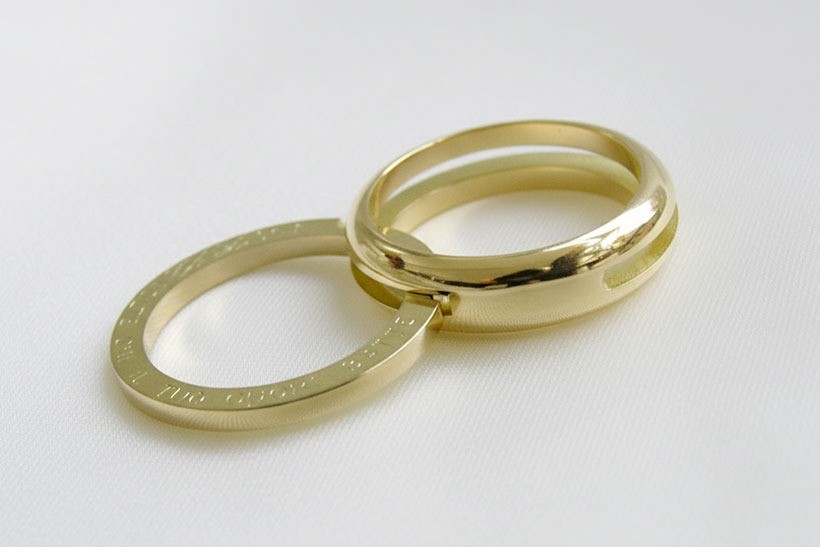
Make your yellow gold gatefold wedding ring unique with an engraving that talks about your love
From idea to metal: how an engraving comes to life on a jewel
At Vannini Gioielli, every engraving begins with a conversation: we understand what you want to express—a date, a monogram, a Florentine motif—and translate the idea into a design that reads clearly on the piece you’ll wear every day.
- Design and paper mock-up: After the brief, we choose letterforms or ornaments and scale them to actual size to test curvature and spacing. The paper draft lets you see proportions and the rhythm of the line at a glance; when everything works—style, placement, legibility—we move to metal.
- Metal and finish selection: The metal defines the engraving’s light: gold enhances the burin’s bright cuts; platinum and white gold favor clean lines; silver offers strong contrast. The finish completes the effect—high polish for intense reflections, satin or sandblasted to increase contrast, with optional patination to make the motif stand out. We always verify thicknesses and geometry for the desired depth.
- Engraving and finishing: The master engraver modulates angle and pressure to achieve lively cuts, gradations, and micro-hatching that give the motif depth. Finishing touches—polishing the cuts, targeted stippling, small chasing interventions—shape the volumes and improve legibility. After a final check for crispness and tactile comfort, your personalized engraved jewel is ready: warm, durable, and truly unique.
At Vannini Gioielli, engraving is part of the design itself: we start from the idea, study proportions and legibility on the metal, proof the mark, then engrave with millimetric care. Whether wedding bands, bracelets, or personalized pieces, every detail is calibrated to harmonize with volume, finish, and everyday wear. If you’d like an engraving based on your drawing—or a creative proposal—our workshop will guide you to the technique and stroke that suit you best.
Book an appointment or visit our atelier: we’ll design the engraving that speaks for you.