

In the heart of the city, among the alleys that run along the Arno and under the silent gaze of Brunelleschi’s Dome, one of the highest expressions of Florentine goldsmithing is still preserved today.: the Florentine goldsmithing style.
A tradition unique in the world, where art meets technique, and history blends with innovation.
This article was written to tell the story of the deep roots of the Florentine goldsmithing style, to highlight its unique features, and to emphasize the importance of safeguarding its identity.
Because choosing a piece of jewelry made according to the principles of Florentine goldsmithing means choosing authenticity and excellence.
History and Origins of the Florentine Goldsmithing Style
The Florentine goldsmithing style has its roots in the Middle Ages, when the art of engraving, chasing and fretwork began to stand out as one of the highest forms of artisanal expression in the city.
With the Renaissance, Florence became a driving force of art and beauty, and Florentine goldsmithing followed in its evolution. Great masters like Benvenuto Cellini elevated the figure of the goldsmith to that of an artist, helping to define a style still recognized today for its elegance, balanced forms, and refined metalwork.
But it was in the 19th century, during the Romantic era, that the Florentine style took on a well-defined identity, thanks to a rediscovery of Gothic and Renaissance taste. During this period, Florentine goldsmithing stood out for its deliberate revival of ancient techniques, reinterpreted according to the demands of contemporary taste, destined to become a recognizable stylistic hallmark over time.
Now as then, Florence’s master goldsmiths continue to pass down this knowledge, carefully preserving the secrets of a tradition that has made quality and beauty its most distinctive traits.
The Evolution of the Florentine Style: From Medieval Workshops to Renaissance Schools
Since the Middle Ages, Florentine goldsmith workshops have been at the heart of artistic production and the transmission of manual knowledge.
It is within these workshops that the Florentine goldsmithing style was born and took shape, through a process of observation, practice, and daily repetition. Here, the apprentice — traditionally called the barzotto — would work alongside the master artisan, learning the fundamental gestures of the craft: from ornamental design to fretwork and engraving, from texturing to chiseling.
A profession passed down through generations, preserved in the focused silence of the workshops, where every detail is cared for with dedication and precision.
During the 19th century, alongside workshop apprenticeships, Florence saw the emergence of its first schools dedicated to artisan training. Institutions such as the Istituto d’Arte di Porta Romana (founded in 1869), the Scuola degli Artigianelli, and the Pio Istituto de’ Bardi became essential points of reference for those aspiring to become goldsmiths.
Attention to detail, balance of form, and a nod to the classical motifs of the Renaissance: everything was designed to educate the eye and the hand in the creation of beauty, in the name of tradition.
Even today, this dual path — workshop and school — remains the driving force that keeps the Florentine style alive. Not just as an aesthetic, but as a material and visual culture capable of crossing centuries without ever losing its identity.

Techniques and Characteristics of the Florentine Goldsmithing Style
The Florentine style is instantly recognizable for its refinement and incredible level of detail, but it is in the technique that its true essence is revealed.
Engraved surfaces, the play of light created by openwork, and the harmonious volumes shaped through repoussé and chasing — all contribute to forming a unique visual language, inherited from the Renaissance and perfected over the centuries.
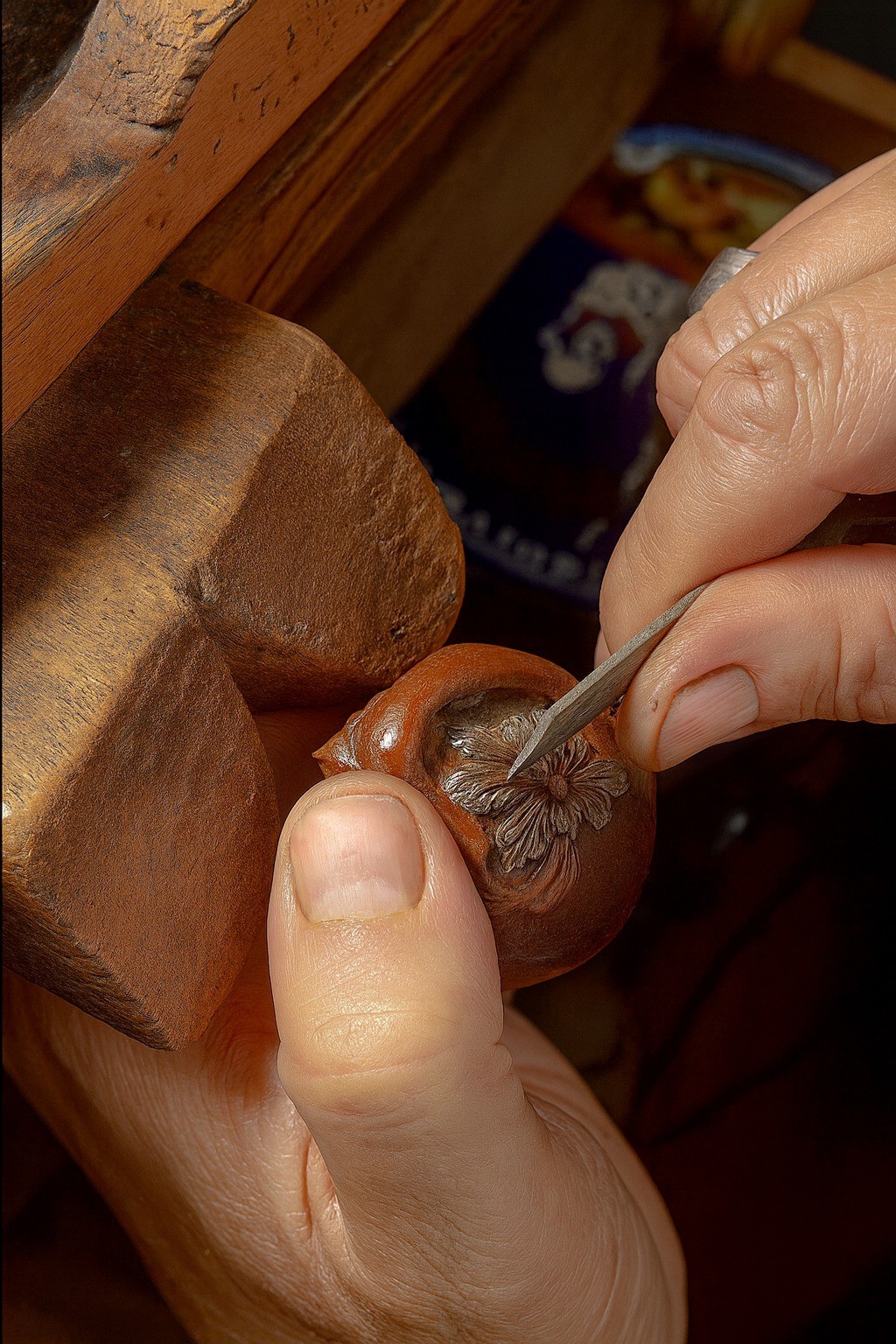
Among the most emblematic techniques are bulino engraving, used to decorate metal with extremely fine and harmonious motifs, and chasing, which gives shape to reliefs and depth through precise, measured blows. Every engraved mark, every shimmering nuance, is born from a deliberate gesture, often repeated hundreds of times — the result of years of experience.
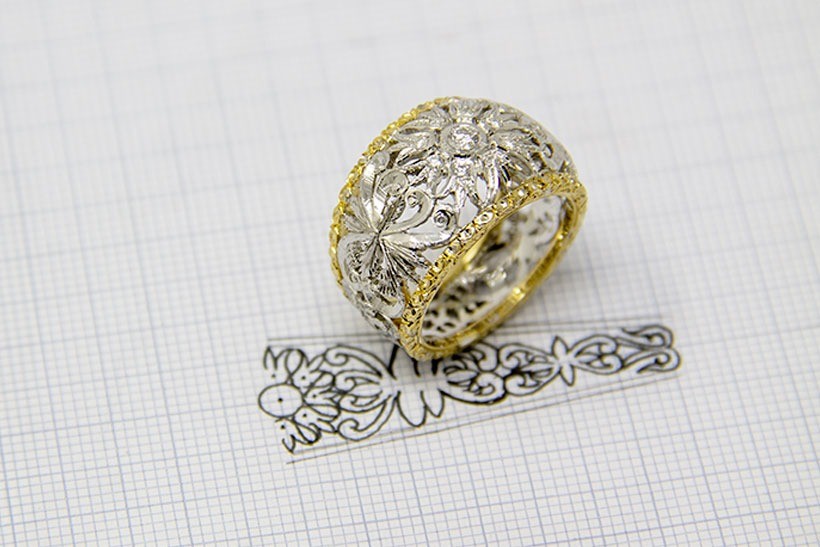
Alongside these are complex processes such as fretwork, which carves the metal into floral, geometric, or vine-like patterns, and graining or matting, which animate the surface with elegant, iridescent textures.
The result is a piece of jewelry that does more than adorn — it tells a story: the story of a Florence that lives on in the artisan’s hand, in the precision of the technique, in the beauty born of tradition.
To learn more about engraving and chasing, you can read this page on our website.
If you’d like to explore the Florentine fretwork technique and see some concrete examples applied to our handcrafted jewelry, we invite you to read this dedicated feature.
How to Recognize an Authentic Piece of Jewelry in the Florentine Style
In a field where appearances can often be deceiving, knowing how to recognize an authentic piece of jewelry in the Florentine style is essential for distinguishing a truly valuable creation from a simple imitation.
There are several unmistakable features that define a genuine piece of Florentine goldsmithing. The first clue is handcraftsmanship: every element — from the structure to the decorative details — is made using artisanal techniques that cannot be replicated by industrial processes. Bulino engraving, piercing, and chasing leave behind vivid marks that speak of the artisan’s touch.
Another key feature is the richness of the surface: not smooth and shiny like mass-produced items, but animated by engravings, textures, openwork, and metal contrasts. Ornamentation such as scrolls, rosettes, and vine motifs are true visual codes that speak the language of the Florentine goldsmithing style.
Finally, authenticity is confirmed by the workshop’s signature, its origin, and, when available, certification proving that the piece was crafted in Florence according to traditional standards. Purchasing from a historic workshop or a trusted jeweler — such as Vannini — is a guarantee of quality and transparency.
The Soul of Florence in the Details: When Jewelry Speaks the Language of the City
What makes the Florentine style instantly recognizable is its extraordinary consistency with the city’s visual identity.
The most recurring ornamental motifs — such as scrolls, foliage, stars, and rosettes — are drawn directly from Florentine Renaissance architecture and decoration. The same forms can be found in the floors of the Baptistery, the frescoed ceilings of historic palaces, and the marble decorations of Santa Maria del Fiore — a visual continuity that still today inspires Florence’s master goldsmiths.
In this sense, the Florentine goldsmithing style stands apart from other Italian or European goldsmithing traditions: it is not merely a regional variation, but a structured aesthetic code, deeply rooted in a specific urban culture — one that finds expression both in monumental architecture and in the fine details of artisanal craftsmanship.
Why the Florentine Style Must Be Protected and Passed Down
In a global market increasingly driven by mass production and standardization, defending the authenticity of a jewel crafted according to the principles of Florentine goldsmithing means contributing to the survival of an artistic language at risk of being distorted by imitations that do not honor tradition.
It means carrying a piece of Florence with you — and choosing to be a part of it.
In a world that leans toward uniformity, Florentine craftsmanship is a refined form of resistance. Every piece made in the Florentine style tells a one-of-a-kind story, born from passion, technique, and individuality.
Choosing a handcrafted jewel means making a conscious choice — one that rewards true value and supports a cultural heritage that deserves to be protected.
If you’re looking for signature jewelry in the Florentine goldsmithing style, you can explore our handcrafted creations on our website or visit us in our workshop in the heart of Florence.