

The Florentine goldsmith's art and its handcrafted jewels
Florentine goldsmiths - with their unique and characteristic jewels - represent one of the highest examples of mastery in the processing of precious stones. Their fame is given by the centuries-old goldsmith tradition of the city, which has established itself and developed from the Middle Ages up to the present day.
But where does this great tradition come from?
And what are the techniques that distinguish it?
In this article you will understand why the handcrafted jewels of Florence are among the most appreciated in the world…
The Florentine goldsmith's art comes from afar
The Florentine goldsmith's art has a long and fascinating history, which dates back to the Middle Ages.
This art takes advantage of various techniques for processing precious stones, some even inherited from the ancient Etruscans.
But it is with the beginning of the Renaissance that the handcrafted jewels of Florence establish themselves throughout Europe as goldsmith excellence.
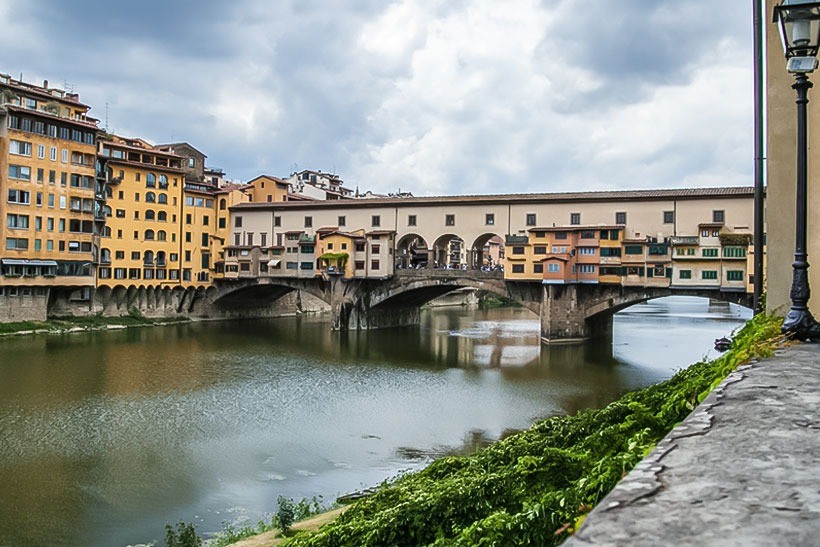
The symbolic place of this excellence is the Ponte Vecchio, where even today it is possible to admire in the windows that characterize this place splendid jewels, linked to tradition.
You must know that in the Ponte Vecchio it has been melted, pierced and chiselled, since 1593, the year in which Ferdinando I de' Medici wanted to gather the main Florentine goldsmith shops in this iconic place.
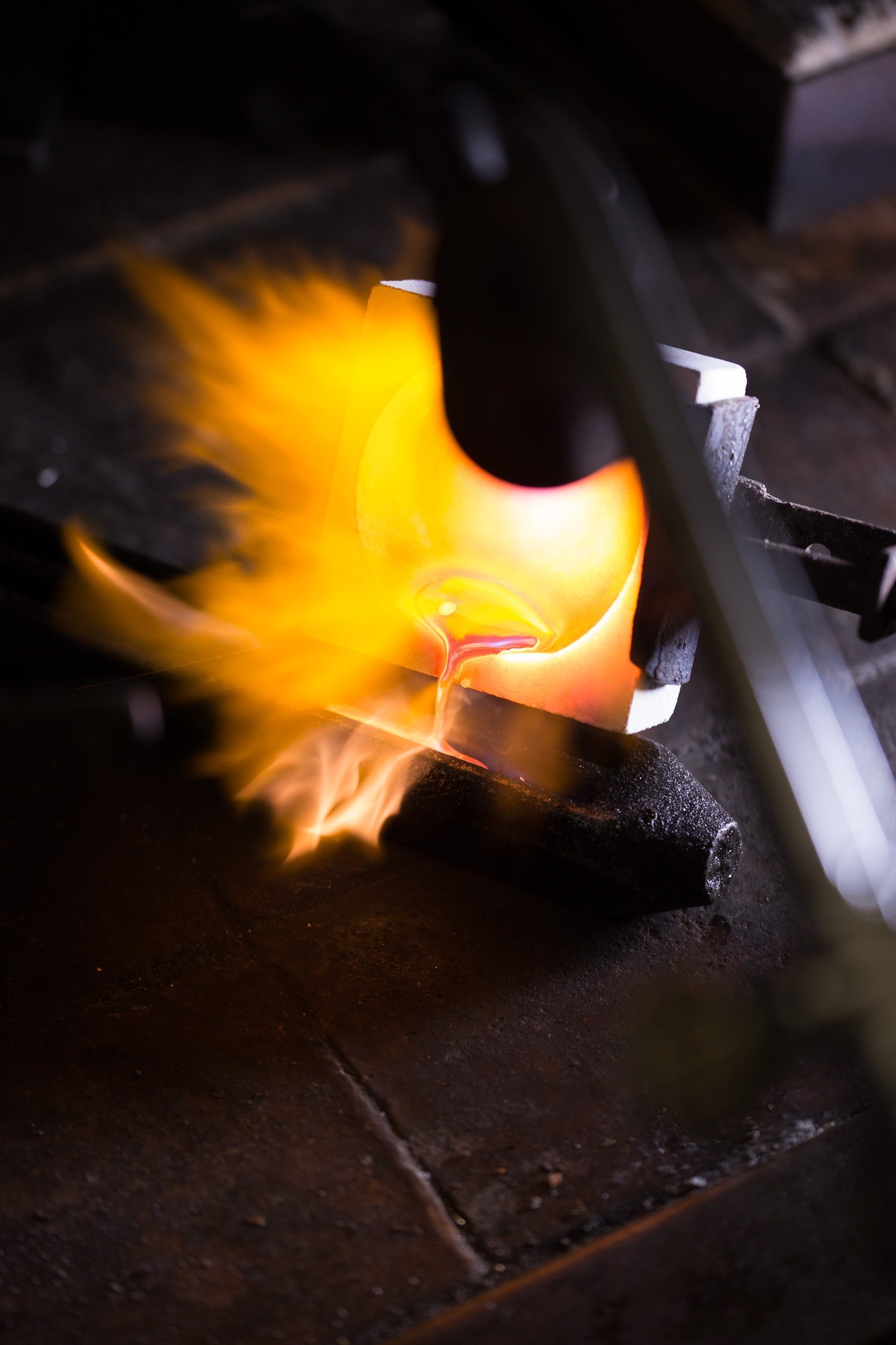
At that time, the goldsmiths of Florence - called "beaters" or "battigello" - used to create jewels for nobles, ecclesiastical figures and wealthy people, combining the use of precious stones and rare metals with the complex techniques of working the precious stones.
Over the years, three different types of jewelery production were distinguished in the city:
A more refined and sumptuous one, open to influences from all over Europe, mostly commissioned by the Florentine court
Another linked to sacred jewellery, equally refined and full of Christian meanings and symbols
Finally, a third type of production, more tied to tradition, mostly aimed at the needs of the nascent bourgeois class
The common denominator of these stylistic currents is the continuous search for elegance and refinement, as well as a maniacal attention to detail.
It should also be remembered that the Florentine goldsmith school played an important role in the history of Italian art and contributed to the creation of masterpieces such as Brunelleschi's dome and Ghiberti's Porta del Paradiso.
In fact, internationally renowned artists such as Brunelleschi himself, Ghiberti, Donatello and many others, were born as craftsmen and trained in goldsmith's workshops, one of the most flourishing businesses in Florence at that time.
The techniques that distinguish the goldsmith's art of Florence
The techniques that distinguish the goldsmith's art in Florence are many, but these three stand out in particular:
- The engraving technique
- The granulation technique
- The fretwork technique (used in Florence and beyond)
Engraving technique
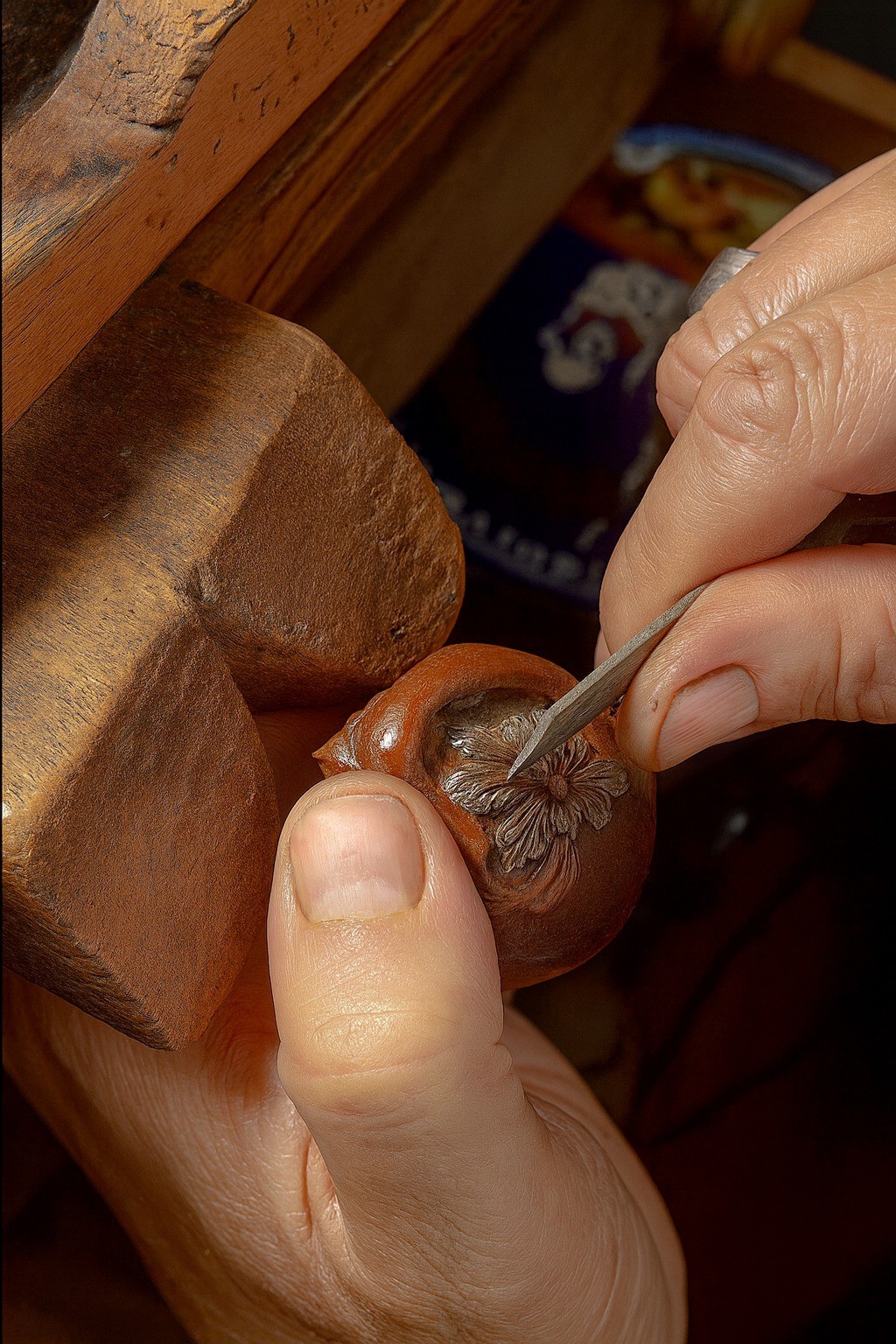
The engraving technique is a gold working technique which consists of carving the surface of the jewel with engravings to create a decorative pattern.This technique, although widespread throughout the world, has been used for centuries by the Florentine goldsmith school to create characteristic jewels of great beauty and refinement.
To make a jewel with the engraving technique, first of all the motif that you want to create is drawn on the surface of the jewel. After that, a special tool is used to engrave the design on the surface of the jewel, to create a relief or carving effect.
As you can imagine, this technique requires a lot of precision and manual skill, the incisions must be made with great attention to detail to create a harmonious and homogeneous effect. Furthermore, the incision must be made with adequate pressure in order not to damage the surface of the jewel.
This technique creates an effect of light and shadow which gives the jewel a feeling of depth and three-dimensionality. The final result is often a jewel with a particular and fascinating appearance.
With this technique you can create complex and detailed patterns.
Granulation technique
The granulation technique is an ancient goldsmith's technique which the artisan jewelery of Florence inherited from the ancient Etruscan goldsmiths.This technique consists in applying small gold balls on the surface of the jewel to create a decorative pattern.
To make a jewel with the granulation technique, first of all the gold balls are prepared. These can be created using a special tool that allows you to obtain small gold spheres of the same size.
Finally, the balls are applied to the surface of the jewel, using a silver or copper alloy as a base to weld the balls.
The granulation technique requires great precision, because the gold balls must be applied evenly to the surface of the jewel, in order to create a harmonious and homogeneous effect.
Furthermore, it is important that the balls are welded in an excellent way, to prevent them from detaching over time.
Thanks to the granulation, very characteristic motifs can be obtained, which give the jewel a refined style.
In our Vannini goldsmith, we exploit these ancient techniques of the Florentine tradition to create jewels that stand out on the market. Techniques that you can find in our latest creations.
Fretwork technique
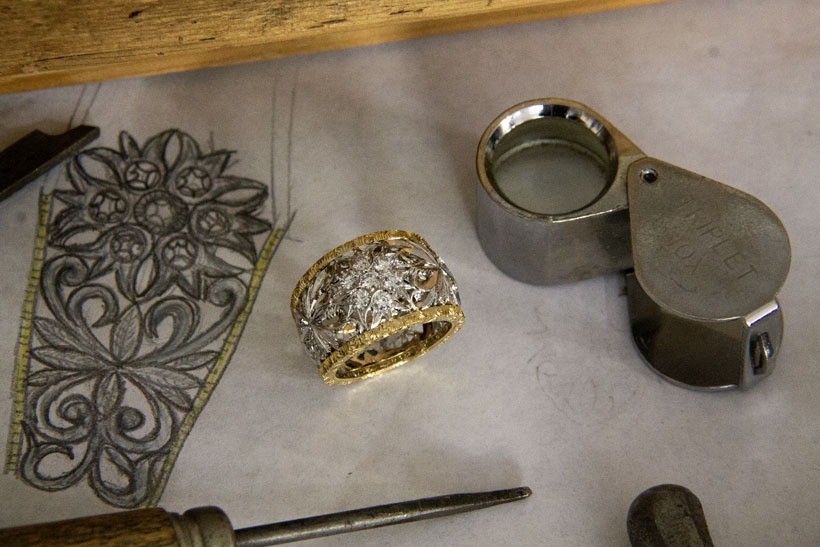
The fretwork technique is a very ancient manufacturing technique which consists in carving a sheet of precious metal to create a decorative motif, used in Florence and beyond.There are traces of this technique already in Roman and Byzantine times and it was originally born to save on material costs and make the creation lighter. Only later did it become a highly sought-after process that made the jewel much more valuable.
The fretwork is in fact very laborious, requiring great skill and precision:
First of all, draw the pattern you want to create on the gold foil.
Then a punch is used to etch the design into the surface of the foil.
Finally, a hacksaw is used to cut the gold foil following the engraved design, until the desired decorative motif is obtained.
This technique requires a lot of patience and attention to detail, but the final result is unique and surprising: the motifs that can be created are very particular and detailed, such as flowers, animals or human figures for example.
The jewel obtained with the fretwork technique is often very refined and can be considered as a work of art.
However, it is also a very fragile jewel and requires special care to preserve its integrity over time.
The master jewelers of our Vannini Gioielli goldsmith workshop are experts in using the ancient fretwork technique, which they use to create unique and unforgettable jewels.
Here is a video that shows the complex work we dedicate to the creation of these small works of art.
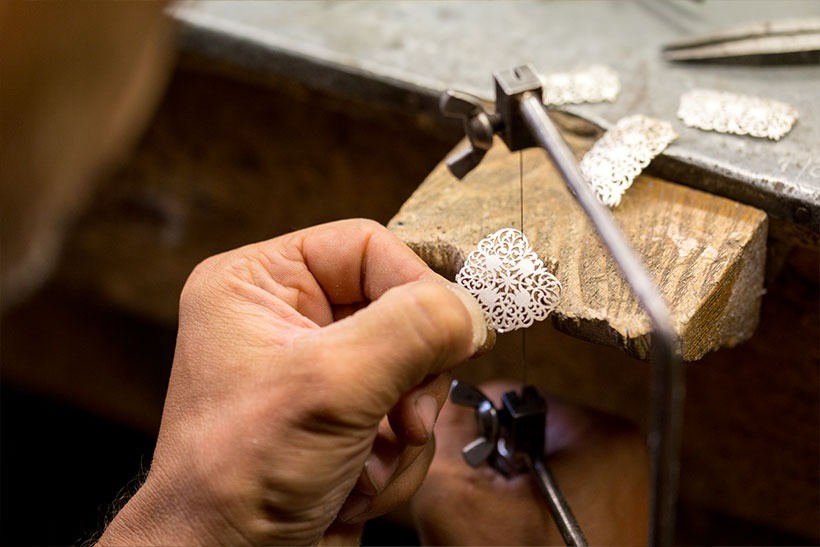
An example of use of the fretwork technique in our workshop.
The Florentine goldsmith shops today
Today, Florentine goldsmith shops are still very active and are considered some of the best in the world.
This is possible because the Florentine goldsmith's art is a cultural heritage of inestimable value which has contributed to the history of Italian art.
Thanks to their mastery, Florentine goldsmiths have created unique pieces over the centuries that survive the various fashions and still enjoy admirers from all over the world.
Many of these shops are real art galleries, where you can admire and buy jewels that you won't find in other places.
Vannini Gioielli draws its inspiration from the great Florentine school of the Renaissance and with the same vigour, with the same passion and humility of the masters, it generates unique precious objects - rings, bracelets, necklaces, earrings and various accessories - carefully designed and made with the 50 years of work experience.
Among the various goldsmith craftsmanship, what distinguishes our "goldsmith workshop" is certainly the fretwork, the main component of classic workmanship or modern style jewels.
In our laboratory we also carry out customizations created entirely according to your personal needs.
If you are looking for designer jewelry inspired by the Florentine goldsmith tradition, you can view our handcrafted models on our website, or you can come and visit us in our jewelry store in Florence, so you can admire our small works of art in person .