

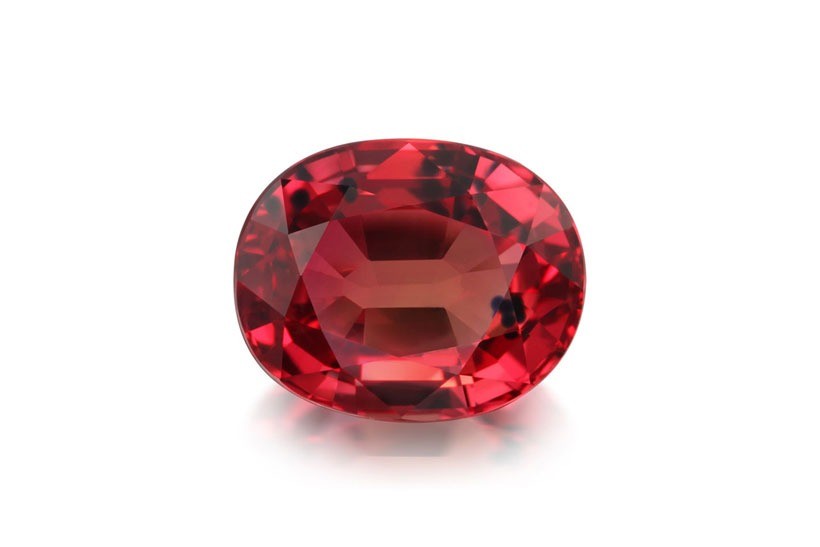
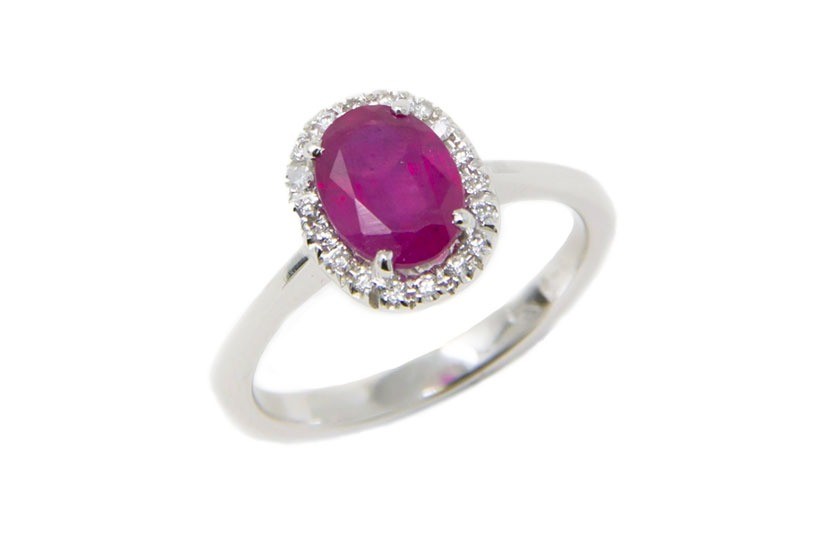
Ruby is the most precious variety of corundum, a mineral made up mostly of aluminum oxide and chromium. Its most distinctive feature is its red colour, which in truth, based on the percentage of chromium oxide, can vary from pale pink to orange to red to purple. In fact, pure corundum is colorless, and it is the presence of chromium that gives it a red colour, which is why rubies are so sought after.
There is a lot to discover about rubies, the existing types, their characteristics and origins: let's discover all of this together in the course of this article.
The characteristics of the ruby
Ruby is one of the hardest gemstones. In fact, not everyone knows that its hardness is slightly lower than that of diamond.
Precisely for this characteristic it is resistant to the action of external abrasive agents, manages to maintain its brilliance and is very resistant to shocks. This makes rubies very suitable for making rings, because compared to other precious stones they do not suffer damage in the event of bumps and scratches.
Another interesting feature of the ruby is that they often have needle-like crystalline inclusions, in fact perfectly pure rubies are rarely found. These crystalline inclusions actually enhance the gem because they accentuate its brilliance and brightness of color. Furthermore, the presence of these small inclusions makes it easier to recognize the authenticity of a ruby.
The color and cut of the rubies
Rubies are mainly extracted from veins present in deposits of metamorphic rocks. The color, as we have already mentioned, is linked to the percentage of chromium present in the gem, and varies from pink to orange to red, sometimes even varying towards blue when there is also a presence of iron. In fact, the most appreciated rubies are those from Burma, with a particular tint of red called "pigeon's blood", a red characterized by light blue hues.
The presence of chromium also causes a phenomenon of fluorescence, a characteristic used to verify the authenticity of a ruby.
As for the cuts used for rubies, the most used and considered the best is the cabochon. In fact, this type of cut makes it possible to enhance the color and refraction of light, as well as the characteristic phenomenon of asterism of some rubies, or the starry reflections that can be admired in some of these precious stones.
The carat weight of rubies
The chromium, which infiltrates the gem during the formation process, causes imperfections and cracks in the ruby. For this reason, no quality ruby can reach very large dimensions, which usually reach a maximum of 3 carats in weight.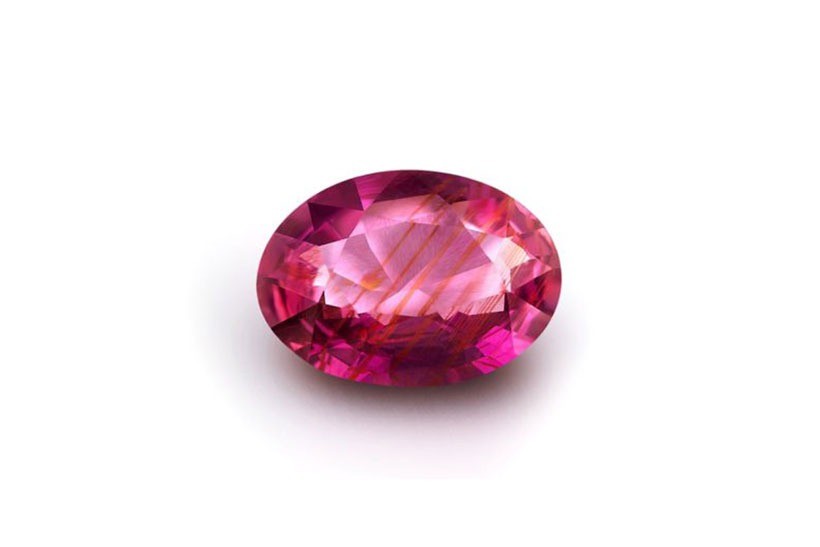
The quality and consequent value of rubies are linked to the colour, transparency, weight and cut of the stone. The intense dark red color, free from imperfections, is the most sought after.
Rubies from Myanmar deposits are among the most sought after for their bright red color with shades of blue and for their incredible luminosity, which can be admired when the stone is exposed to any type of light. These are very rare gems that are extracted from a place whose name is surrounded by an aura of legend, namely the Valley of the Rubies. Even though Myanmar is still the country where rubies are mined the most, it is reported that its deposits are running low.
From Thailand come very beautiful and appreciated rubies that have brown hues. The inclusions present sometimes create particular refraction effects like a cat's eye or a star, based on how the crystallizations are arranged inside the stone. The star reflections make the rubies very precious and are enhanced with the cabochon cut, which allows you to create the illusion that the star flows over the surface of the stone.
Other deposits of rubies are found in Vietnam, from which stones with light blue hues come, but also in India, Pakistan and Cambodia.
In recent decades, some deposits have also been discovered in Africa from which rubies are extracted, highly appreciated for their very bright color and large size.
As far as Europe is concerned, the only point of reference is Macedonia, where stones with a particular raspberry red color are extracted.
Ruby rarity and fakes
Rubies are extremely rare and precious, especially due to the difficulty of finding pure and quality stones in nature.
Precisely for this reason, in the past it was common to run into the sale of fake stones, mistaken for rubies due to their red color, such as topaz or red zircons. Today the most modern techniques of analysis allow to recognize an authentic ruby. With the sophisticated systems available today it is possible to observe the stones in depth.The synthetic rubies
The first synthetic rubies were made already in the early twentieth century.Synthetic rubies are produced using the Verneuil process. These stones have characteristics so similar to genuine stones that only an expert can tell them apart. They have a regular shape and a clear and bright colour, and are used to make accessories and costume jewelery.
Curiosities about rubies
-The most expensive ruby in the world comes from Burma and was sold in 2015 at a Sotheby's auction for a record $30 million.
-Other things being equal, a large ruby is rarer (and therefore more valuable) than a diamond of the same size.
-The largest ruby suitable for cutting, weighing 400 ct, was found in Myanmar and divided into three parts.
-The ancient Greeks thought that these stones left in the sun turned into hot coals, absorbing the power of the sun. Not surprisingly, it is the stone of the month of July.
-One of Queen Elizabeth's most loved jewels was the Burmese tiara, made with 96 rubies, donated in 1947 by the Burmese people for her marriage to Philip. Why exactly 96? Because it was believed to be the number of possible diseases that can affect the human body.