

Art and goldsmithing: the jewels in Botticelli's La Primavera
As we were able to discover in our previous article "Jewels and Art History: fascinating interweaving", the history of art is dotted with wonderful links between painting and goldsmithing.
Talented artists enriched their skills by ranging between different arts and inspirations, creating creations that merged culture and beauty in their artistic creations.
Today we will be able to explore one of the most famous paintings in the world by focusing precisely on the aspect of the jewels that are represented in it.
We are talking about Botticelli's Spring, a very famous painting that celebrates the blossoming of life in nature.
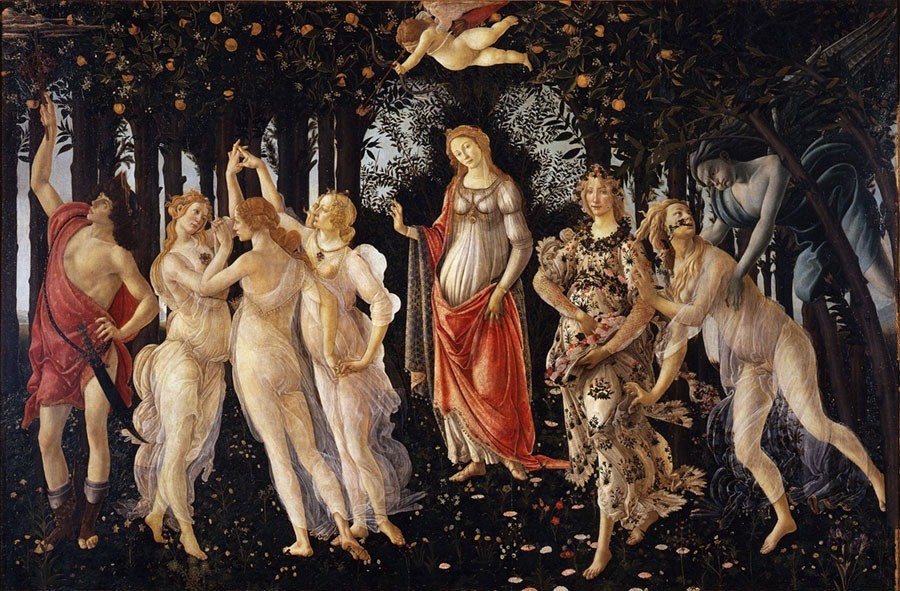
Botticelli's Spring
Sandro Botticelli's masterpiece represents one of the artist's most important and appreciated paintings, considered the most relevant creation of his "profane period" and today it has become a true emblem of Florentine painting of the Laurentian age.
According to studies, the work would be dated between 1482 and 1485 and was created for Lorenzo di Pierfrancesco de' Medici, cousin of Lorenzo the Magnificent.
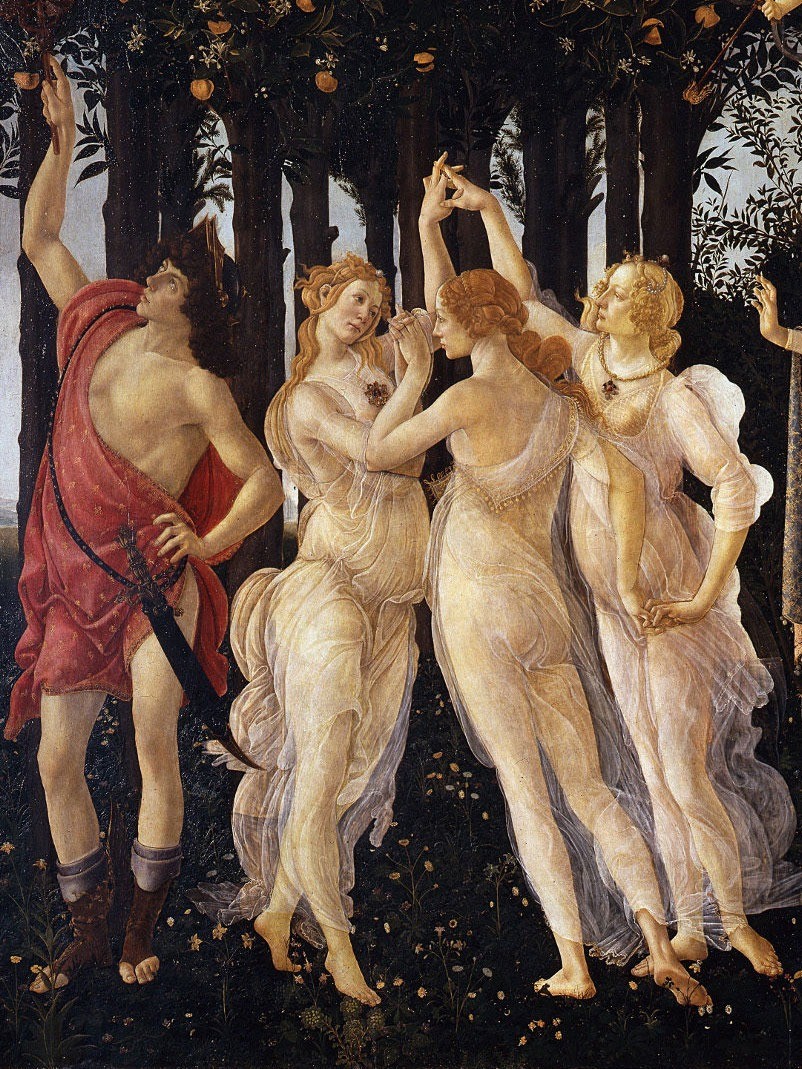
The scene depicted is set in a dense grove of flowering trees full of fruit, while at the feet of the subjects we see a large meadow where more than 100 varieties of flowers typical of the Florentine countryside can be seen in spring.
Within the scene we can see nine characters, who are inspired by classical mythology to create a painting with a strong allegorical connotation.
The characters represented are, starting from the centre, Venus, the goddess of love; above her Cupid, her son, intent on throwing a flaming dart; on the right Zefiro, the personification of the spring wind, who is behind the nymph Cloris, later also depicted as Flora, a representation of spring; on the left is Mercury, who with the caduceus drives away the clouds so that the sky remains clear.
Between Mercury and Venus we can see three female figures intent on dancing in a circle holding hands. These figures are interpreted as the Graces, divinities of beauty, nature and vegetation.
They are dressed in transparent veils and wear refined jewels, which recall Sandro Botticelli's goldsmith training.
The Necklace of Beauty
Both the Grace on the right, interpreted as Voluptuousness, and the one on the left, or Beauty, are wearing precious necklaces.
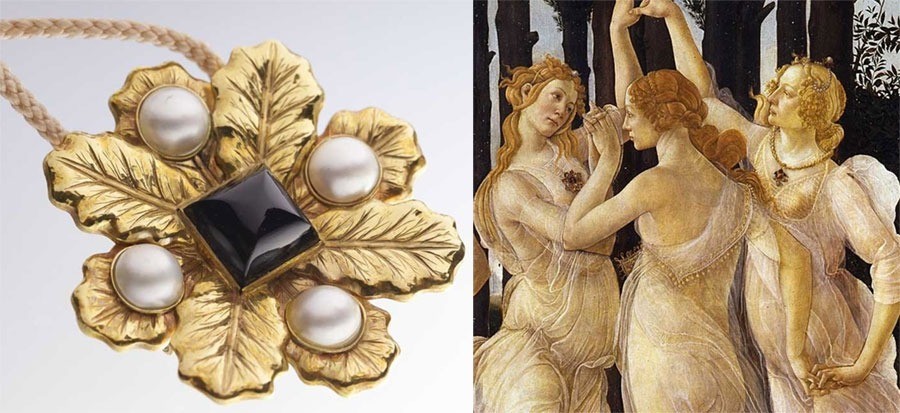
In particular, the Beauty wears an elegant pendant around her neck. The jewel has a particular shape, which follows the theme of nature and the flowering of spring: the jewel in fact consists of golden leaves, embellished in the center by a gem and four pearls.
Botticelli: origin of his nickname and Florentine goldsmithing
The theme of goldsmithing is also linked to the curious origin of Botticelli's nickname. In fact, it seems that Alessandro Filipepi owes his nickname, by which he is widely known today, precisely to the Florentine art of working gold.
Botticelli was born and lived almost all of his life in Florence, one of the greatest centers of the goldsmith's art. One of the hypotheses on the birth of the nickname is precisely that it derives from a variation of the term with which, in Florence, we referred to the profession of goldsmith: the "goldbeater", in fact, was also called "battigello".
In his life Alessandro Filipepi also undertook goldsmithing activities, like his brother Giovanni who did exactly that job. However, Botticelli fell in love with pictorial art and soon became an apprentice of Filippo Lippi, one of the greatest exponents of Florentine painting.
However, his goldsmith training will not be forgotten: it emerges in fact in his paintings, in the delicate details, in the golden finishes that embellish his masterpieces, in the jewels he reproduces with elegant beauty.
Reproduction of Botticelli's Primavera pendant
The Florentine goldsmith tradition comes from far away, and even today it is possible to find creations of craftsmanship and finesse made by the hands of master goldsmiths.
This is the case, for example, of the creations of the artisans of our goldsmith's shop in Florence.
In fact, in our workshop numerous artistic reproductions have been made, which recreate with a wealth of refined details some of the most beautiful jewels present in many works of art, or goldsmith creations that take inspiration from artistic works of many genres to create jewels that recall the history, culture and artistic style of the past.
Even the pendant from Botticelli's Spring has been reproduced by us: if you want to see our creation, you can click here.
If, on the other hand, you are curious to discover all the other historical reproductions we have made, you can also consult the dedicated section of our website.
Realizations of Florentine goldsmith's art
If you are looking for a handmade jewel with the care of a Florentine master craftsman, you can rely on our goldsmith shop.Consult our online shop or come and visit us in our goldsmith's shop in Florence.